mirror of
https://github.com/robbert-vdh/yabridge.git
synced 2026-05-07 03:50:11 +02:00
 Robbert van der Helm
1c2418d4d8
Robbert van der Helm
1c2418d4d8
Most references to symlinks have been removed since this only caused
confusion and yabridge 2.1.0 will no longer require manual PATH setup i
most cases.
581 lines
29 KiB
Markdown
581 lines
29 KiB
Markdown
# yabridge
|
|
|
|
[](https://github.com/robbert-vdh/yabridge/actions?query=workflow%3A%22Automated+builds%22+branch%3Amaster)
|
|
|
|
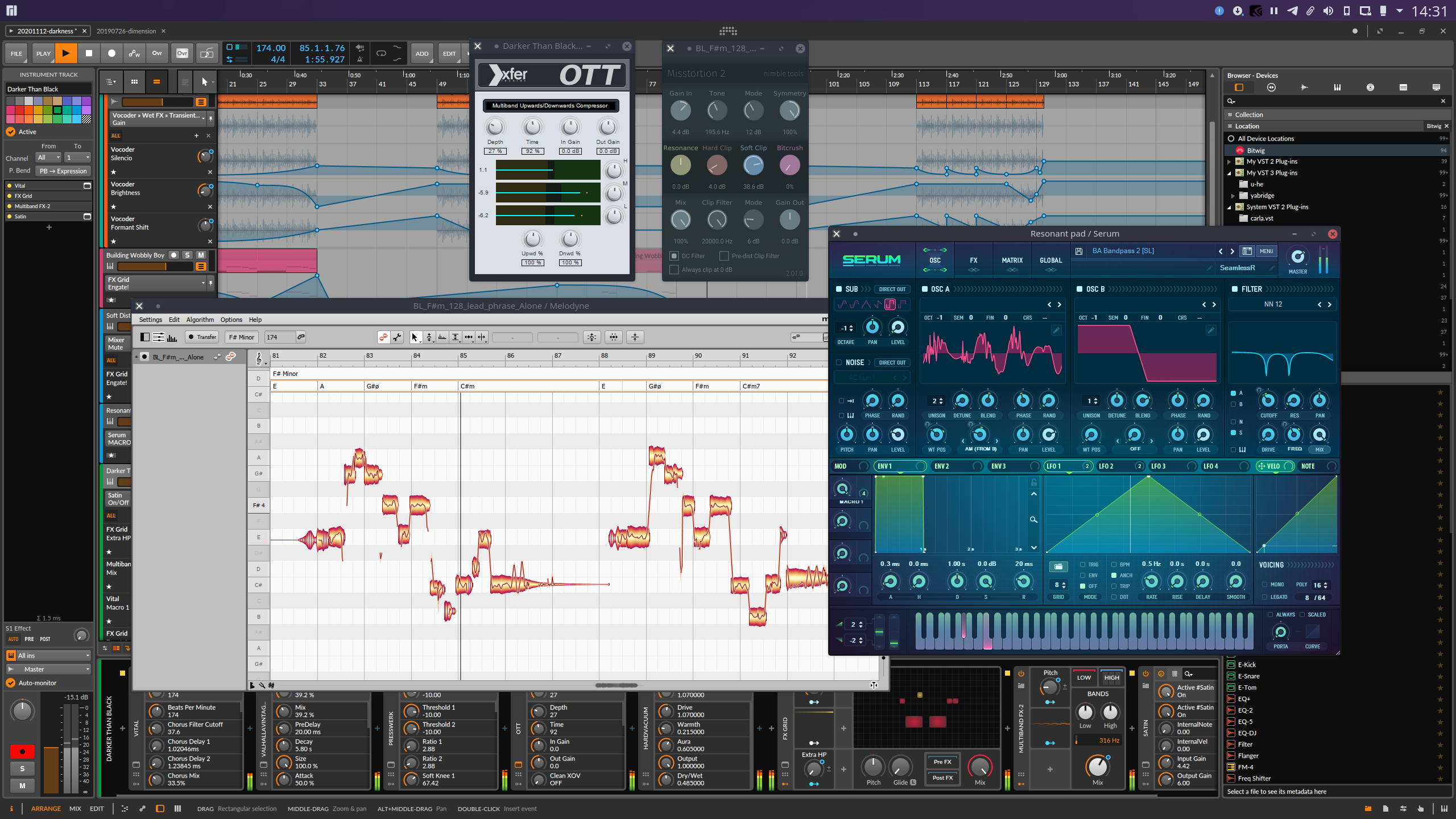
Yet Another way to use Windows VST plugins on Linux. Yabridge seamlessly
|
|
supports running both 64-bit Windows VST2 plugins as well as 32-bit Windows VST2
|
|
plugins in a 64-bit Linux VST host, with optional support for inter-plugin
|
|
communication through [plugin groups](#plugin-groups). Its modern concurrent
|
|
architecture and focus on transparency allows yabridge to be both fast and
|
|
highly compatible, while also staying easy to debug and maintain.
|
|
|
|
|
|
|
|
### Table of contents
|
|
|
|
- [Tested with](#tested-with)
|
|
- [Usage](#usage)
|
|
- [Automatic setup (recommended)](#automatic-setup)
|
|
- [Manual setup](#manual-setup)
|
|
- [DAW setup](#daw-setup)
|
|
- [Bitbridge](#bitbridge)
|
|
- [Wine prefixes](#wine-prefixes)
|
|
- [Search path setup](#search-path-setup)
|
|
- [Configuration](#configuration)
|
|
- [Plugin groups](#plugin-groups)
|
|
- [Compatibility options](#compatibility-options)
|
|
- [Example](#example)
|
|
- [Troubleshooting common issues](#troubleshooting-common-issues)
|
|
- [Performance tuning](#performance-tuning)
|
|
- [Runtime dependencies and known issues](#runtime-dependencies-and-known-issues)
|
|
- [Building](#building)
|
|
- [32-bit bitbridge](#32-bit-bitbridge)
|
|
- [Debugging](#debugging)
|
|
- [Attaching a debugger](#attaching-a-debugger)
|
|
|
|
## Tested with
|
|
|
|
Yabridge has been tested under the following VST hosts using Wine Staging 5.9:
|
|
|
|
- Bitwig Studio 3.2 and the betas of Bitwig Studio 3.3
|
|
- Carla 2.2
|
|
- Ardour 6.3
|
|
- Mixbus 6.0.702
|
|
- Qtractor 0.9.18
|
|
- REAPER 6.15
|
|
- Renoise 3.2.1
|
|
|
|
Please let me know if there are any issues with other VST hosts.
|
|
|
|
## Usage
|
|
|
|
You can either download a prebuilt version of yabridge through GitHub's
|
|
[releases](https://github.com/robbert-vdh/yabridge/releases) page, or you can
|
|
compile it from source using the instructions in the [build](#Building) section
|
|
below. Alternatively there are AUR packages available if you are running Arch or
|
|
Manjaro ([yabridge](https://aur.archlinux.org/packages/yabridge/),
|
|
[yabridge-bin](https://aur.archlinux.org/packages/yabridge-bin/),
|
|
[yabridge-git](https://aur.archlinux.org/packages/yabridge-git/)).
|
|
|
|
### Automatic setup (recommended)
|
|
|
|
The easiest way to get up and running is through
|
|
[yabridgectl](https://github.com/robbert-vdh/yabridge/tree/master/tools/yabridgectl).
|
|
You can download yabridgectl from GitHub's [releases
|
|
page](https://github.com/robbert-vdh/yabridge/releases). There are also AUR
|
|
packages available if you're running Arch or Manjaro
|
|
([yabridgectl](https://aur.archlinux.org/packages/yabridgectl/),
|
|
[yabridgectl-git](https://aur.archlinux.org/packages/yabridgectl-git/), and it's
|
|
also included in
|
|
[yabridge-bin](https://aur.archlinux.org/packages/yabridge-bin/)). More
|
|
comprehensive documentation on yabridgectl can be found in its
|
|
[readme](https://github.com/robbert-vdh/yabridge/tree/master/tools/yabridgectl),
|
|
or by running `yabridgectl --help`.
|
|
|
|
First, yabridgectl needs to know where it can find yabridge's files. If you have
|
|
downloaded the prebuilt binaries, then you can simply extract the archive to
|
|
`~/.local/share` and both yabridge and yabridgectl will pick up the files in
|
|
`~/.local/share/yabridge` automatically. You also won't have to do any
|
|
additional work if you're using one of the AUR packages. If you have compiled
|
|
yabridge from source or if you installed the files to some other location, then
|
|
you can use `yabridgectl set --path=<path>` to tell yabridgectl where it can
|
|
find the files.
|
|
|
|
Next, you'll want to tell yabridgectl where it can find your plugins. For this
|
|
you can use yabridgectl's `add`, `rm` and `list` commands. For instance, to add
|
|
the most common VST2 plugin directory, use `yabridgectl add "$HOME/.wine/drive_c/Program Files/Steinberg/VstPlugins"`. You can use
|
|
`yabridgectl status` to get an overview of the current settings and the
|
|
installation status of all of your plugins.
|
|
|
|
Finally, you can run `yabridgectl sync` to finish setting up yabridge for all of
|
|
your plugins. Simply tell your VST host to search for plugins in the directories
|
|
you've just added using `yabridgectl add` and you'll be good to go. _Don't
|
|
forget to rerun `yabridgectl sync` whenever you update yabridge if you are using
|
|
the default copy-based installation method._
|
|
|
|
### Manual setup
|
|
|
|
Setting up yabridge through yabridgectl is the recommended installation method
|
|
as it makes updating easier and yabridgectl will check for some common mistakes
|
|
during the installation process. To set up yabridge without using yabridgectl,
|
|
first download and extract yabridge's files like in the section above. The rest
|
|
of this section assumes that you have extracted the files to `~/.local/share`
|
|
(such that `~/.local/share/yabridge/libyabridge.so` exists), and that you want
|
|
to set up yabridge for the VST2 plugin called `~/.wine/drive_c/Program Files/Steinberg/VstPlugins/plugin.dll`.
|
|
|
|
Depending on whether you want to use copy or symlink-based installation method,
|
|
you can then set up yabridge for that plugin by creating a copy or symlink of
|
|
`libyabridge.so` next to `plugin.dll` called `plugin.so`. For the example, you
|
|
can use either:
|
|
|
|
```shell
|
|
# For the copy-based installation method
|
|
cp ~/.local/share/yabridge/libyabridge.so "$HOME/.wine/drive_c/Program Files/Steinberg/VstPlugins/plugin.so"
|
|
# For the symlink-based installation method
|
|
ln -sf ~/.local/share/yabridge/libyabridge.so "$HOME/.wine/drive_c/Program Files/Steinberg/VstPlugins/plugin.so"
|
|
```
|
|
|
|
The symlink-based installation method will not work with any host that does not
|
|
individually sandbox its plugins. If you are using the copy-based installation
|
|
method, then don't forget to overwrite all copies of `libyabridge.so` you
|
|
created this way whenever you update yabridge.
|
|
|
|
### DAW setup
|
|
|
|
Finally, open your DAW's VST location configuration and tell it to look for
|
|
plugins under `~/.wine/drive_c/Program Files/Steinberg/VstPlugins`, or whichever
|
|
directories you've added in yabridgectl. That way it will automatically pick up
|
|
all of your Windows VST2 plugins.
|
|
|
|
### Bitbridge
|
|
|
|
If you have downloaded the prebuilt version of yabridge or if have followed the
|
|
instructions from the [bitbridge](#32-bit-bitbridge) section below, then
|
|
yabridge is also able to load 32-bit VST plugins. The installation procedure for
|
|
32-bit plugins is exactly the same as for 64-bit plugins. Yabridge will
|
|
automatically detect whether a plugin is 32-bit or 64-bit on startup and it will
|
|
handle it accordingly.
|
|
|
|
### Wine prefixes
|
|
|
|
It is also possible to use yabridge with multiple Wine prefixes. Yabridge will
|
|
automatically detect and use the Wine prefix the plugin's `.dll` file is located
|
|
in. Alternatively you can set the `WINEPREFIX` environment variable to override
|
|
the Wine prefix for all instances of yabridge.
|
|
|
|
### Search path setup
|
|
|
|
This section is only relevant if you're using the _copy-based_ installation
|
|
method and your yabridge files are located somewhere other than in
|
|
`~/.local/share/yabridge`. If you're using one of the AUR packages then you can
|
|
also skip this section.
|
|
|
|
Yabridge needs to know where it can find `yabridge-host.exe`. By default
|
|
yabridge will search your through search path as well as in
|
|
`~/.local/share/yabridge` if that exists. When loading yabridge from a
|
|
non-standard location, such as when building from source, you may have to modify
|
|
your _login shell_'s `PATH` environment variable so that yabridge is able to
|
|
find its files. Yabridgectl will automatically check whether this is set up
|
|
correctly when you run `yabridgectl sync`, and it will show a warning if it
|
|
detects any issues. _If you do not see such a warning after running `yabridgectl sync`, then you can skip this section._
|
|
|
|
To set this, you'll want to add yabridge's installation directory to your login
|
|
shell's `PATH` environment variable. If you're unsure what your login shell is,
|
|
then you can open a terminal and run `echo $SHELL` to find out. For the below
|
|
examples I'll assume you're using the default installation location at
|
|
`~/.local/share/yabridge`.
|
|
|
|
- If you are using the default **Bash** shell, then you will want to add the
|
|
following line to `~/.bash_profile` (or `~/.profile` if it does not exist):
|
|
|
|
```shell
|
|
export PATH="$HOME/.local/share/yabridge:$PATH"
|
|
```
|
|
|
|
- If you are using **Zsh**, then you can add the following line to `~/.zprofile`
|
|
(`~/.zshenv` should also work, but some distros such as Arch Linux overwrite
|
|
`PATH` after this file has been read):
|
|
|
|
```shell
|
|
export PATH="$HOME/.local/share/yabridge:$PATH"
|
|
```
|
|
|
|
- If you are using **fish**, then you can add the following line to either
|
|
`~/.config/fish/config.fish` or some file in `~/.config/fish/conf.d/`:
|
|
|
|
```shell
|
|
set -gp fish_user_paths ~/.local/share/yabridge
|
|
```
|
|
|
|
Rerun `yabridgectl sync` to make sure that the setup has been successful. If the
|
|
environment variable has been set up correctly, you should not be seeing any
|
|
warnings. _Make sure to log out and log back in again to ensure that all
|
|
applications pick up the new changes._
|
|
|
|
### Configuration
|
|
|
|
Yabridge can be configured on a per plugin basis to host multiple plugins within
|
|
a single process using [plugin groups](#plugin-groups), and there are also a
|
|
variety of [compatibility options](#compatibility-options) available to improve
|
|
compatibility with certain hosts and plugins.
|
|
|
|
Configuring yabridge is done through a `yabridge.toml` file located in either
|
|
the same directory as the plugin's `.so` file you're trying to configure, or in
|
|
any of its parent directories. This file contains case sensitive
|
|
[glob](https://www.man7.org/linux/man-pages/man7/glob.7.html) patterns that
|
|
match paths to yabridge `.so` files relative to the `yabridge.toml` file. These
|
|
patterns can also match an entire directory to apply settings to all plugins
|
|
within that directory. To avoid confusion, only the first `yabridge.toml` file
|
|
found and only the first matching glob pattern within that file will be
|
|
considered. See below for an [example](#example) of a `yabridge.toml` file.
|
|
|
|
#### Plugin groups
|
|
|
|
| Option | Values | Description |
|
|
| ------- | ----------------- | ---------------------------------------------------------------------- |
|
|
| `group` | `{"<string>",""}` | Defaults to `""`, meaning that the plugin will be hosted individually. |
|
|
|
|
Some plugins have the ability to communicate with other instances of that same
|
|
plugin or even with other plugins made by the same manufacturer. This is often
|
|
used in mixing plugins to allow different tracks to reference each other without
|
|
having to route audio between them. Examples of plugins that do this are
|
|
FabFilter Pro-Q 3, MMultiAnalyzer and the iZotope mixing plugins. In order for
|
|
this to work, all instances of a particular plugin will have to be hosted in the
|
|
same process.
|
|
|
|
Yabridge has the concept of _plugin groups_, which are user defined groups of
|
|
plugins that will all be hosted inside of a single process. Plugins groups can
|
|
be configured for a plugin by setting the `group` option of that plugin to some
|
|
name. All plugins with the same group name will be hosted within a single
|
|
process. Of course, plugin groups with the same name but in different Wine
|
|
prefixes and with different architectures will be run independently of each
|
|
other. See below for an [example](#example) of how these groups can be set up.
|
|
|
|
#### Compatibility options
|
|
|
|
| Option | Values | Description |
|
|
| --------------------- | -------------- | ---------------------------------------------------------------------------------------------------------------------------------------------------------------------------------------------------------------------------------------------------------------------------------------------------------------------------------------------------------------------------------------------------------------------------------------------------------- |
|
|
| `editor_double_embed` | `{true,false}` | Compatibility option for plugins that rely on the absolute screen coordinates of the window they're embedded in. Since the Wine window gets embedded inside of a window provided by your DAW, these coordinates won't match up and the plugin would end up drawing in the wrong location without this option. Currently the only known plugins that require this option are _PSPaudioware_ plugins with expandable GUIs, such as E27. Defaults to `false`. |
|
|
|
|
These options are workarounds for issues mentioned in the [known
|
|
issues](#runtime-dependencies-and-known-issues) section. Depending on the hosts
|
|
and plugins you use you might want to enable some of them.
|
|
|
|
#### Example
|
|
|
|
All of the paths used here are relative to the `yabridge.toml` file.
|
|
|
|
```toml
|
|
# ~/.wine/drive_c/Program Files/Steinberg/VstPlugins/yabridge.toml
|
|
|
|
# This would cause all plugins to be hosted within a single process. Doing so
|
|
# greatly reduces the loading time of individual plugins, with the caveat being
|
|
# that plugins are no longer sandboxed from eachother.
|
|
#
|
|
# ["*"]
|
|
# group = "all"
|
|
|
|
["FabFilter Pro-Q 3.so"]
|
|
group = "fabfilter"
|
|
|
|
["MeldaProduction/Tools/MMultiAnalyzer.so"]
|
|
group = "melda"
|
|
|
|
# Matches an entire directory and all files inside it, make sure to not include
|
|
# a trailing slash
|
|
["ToneBoosters"]
|
|
group = "toneboosters"
|
|
|
|
["PSPaudioware"]
|
|
editor_double_embed = true
|
|
|
|
# Simple glob patterns can be used to avoid unneeded repetition
|
|
["iZotope*/Neutron *"]
|
|
group = "izotope"
|
|
|
|
# Since this file has already been matched by the above glob pattern, this won't
|
|
# do anything
|
|
["iZotope7/Neutron 2 Mix Tap.so"]
|
|
group = "This will be ignored!"
|
|
|
|
# Of course, you can also add multiple plugins to the same group by hand
|
|
["iZotope7/Insight 2.so"]
|
|
group = "izotope"
|
|
```
|
|
|
|
## Troubleshooting common issues
|
|
|
|
- If you're using the copy-based installation method and plugins are getting
|
|
skipped or blacklisted immediately when your VST host is scanning them, then
|
|
this is likely caused by `yabridge-host.exe` not being found in your search
|
|
path. See the [search path setup](#search-path-setup) section for instructions
|
|
on how to fix this.
|
|
|
|
- If you're using the symlink installation method and you're seeing multiple
|
|
duplicate instances of the same plugin, or after opening a single plugin every
|
|
subsequent plugin opens as another instance of that first plugin, then your
|
|
VST host is not sandboxing individual plugins. If you're using Bitwig Studio,
|
|
the make sure the '_Per plugin-in_'` or '_Individually_' plugin hosting mode
|
|
is enabled and all of the checkboxes in the list of sandboxing exceptions are
|
|
left unchecked.
|
|
|
|
- If you're not using yabridgectl and a plugin is not getting picked up at all,
|
|
then you can verify that the symlink or copy is correct by running:
|
|
|
|
```shell
|
|
readelf -s ~/.wine/drive_c/path/to/plugin.so | grep yabridge
|
|
```
|
|
|
|
The output should contain several lines related to yabridge.
|
|
|
|
- If you're seeing errors related to Wine either when running `yabridgectl sync`
|
|
or when trying to load a plugin, then it can be that your installed version of
|
|
Wine is much older than the version that yabridge has been compiled for.
|
|
Yabridgectl will automatically check for this when you run `yabridgectl sync`
|
|
after updating Wine or yabridge. You can also manually verify that Wine is
|
|
working correctly by running one of the VST host applications. Assuming that
|
|
yabridge is installed under `~/.local/share/yabridge`, then running
|
|
`~/.local/share/yabridge/yabridge-host.exe` directly (so _not_
|
|
`wine ~/.local/share/yabridge/yabridge-host.exe`, that won't work) in a
|
|
terminal should print a few messages related to Wine's startup process
|
|
followed by the following line:
|
|
|
|
```
|
|
Usage: yabridge-host.exe <vst_plugin_dll> <endpoint_base_directory>
|
|
```
|
|
|
|
If you're seeing a `002b:err:module:__wine_process_init` error instead, then
|
|
your version of Wine is too old for this version of yabridge and you'll have
|
|
to upgrade your Wine version. Instructions for how to do this on Ubuntu can be
|
|
found on the [WineHQ website](https://wiki.winehq.org/Ubuntu).
|
|
|
|
- Timeout errors during plugin scanning are caused by the Wine process not being
|
|
able to start. There should be plugin output messages in your DAW or terminal
|
|
that with more information on what went wrong.
|
|
|
|
- Sometimes left over Wine processes can cause problems. Run `wineserver -k` to
|
|
terminate Wine related in the current or default Wine prefix.
|
|
|
|
- If you're using a _lot_ of plugins and you're unable to load any new plugins,
|
|
then you may be running into Xorg's client limit. The exact number of plugins
|
|
it takes for this to happen will depend on your system and the other
|
|
applications running in the background. An easy way to check if this is the
|
|
case would be to try and run `wine cmd.exe` from a terminal. If this prints a
|
|
message about the maximum number of clients being reached (or if you are not
|
|
able to open the terminal at all), then you might want to consider using
|
|
[plugin groups](#plugin-groups) to run multiple instances of your most
|
|
frequently used plugins within a single process.
|
|
|
|
## Performance tuning
|
|
|
|
Running Windows VST plugins under Wine should have minimal performance impact,
|
|
but you may still notice an increase in audio spikes and overall processing
|
|
latency. Luckily there are a few things you can do to get rid of most or all of
|
|
these negative side effects:
|
|
|
|
- First of all, you'll want to make sure that you can run programs with realtime
|
|
priorities. Note that on Arch and Manjaro this does not necessarily require a
|
|
realtime kernel as they include the `PREMPT` patch set in their regular
|
|
kernels. You can verify that this is workign correctly by running
|
|
`chrt -f 10 whoami`, which should print your username.
|
|
|
|
- The other even more important thing you can do is to use a build of Wine with
|
|
Proton's fsync patches. This can improve performance significantly, especially
|
|
when using a lot of plugins at the same time. If you're running Arch or
|
|
Manjaro, then you can use the
|
|
[wine-nspa](https://github.com/nine7nine/pkgbuilds_nspa/tree/master/wine-nspa)
|
|
PKGBUILD for an audio production optimized version of Wine Staging 5.9, or
|
|
[wine-tkg](https://github.com/Frogging-Family/wine-tkg-git) for a more up to
|
|
date version with a different patch set. Aside from a patched copy of Wine
|
|
you'll also need a supported kernel for this to work. Manjaro's kernel
|
|
supports fsync out of the box, and on Arch you can use the `linux-zen` kernel.
|
|
Finally you'll have to set the `WINEFSYNC` environment variable to `1` to
|
|
enable fsync. See the [search path setup](#search-path-setup) section for more
|
|
information on where to do this. You can use the following command to check if
|
|
this is set correctly:
|
|
|
|
```shell
|
|
env -i HOME="$HOME" $SHELL -l -c 'echo $WINEFSYNC'
|
|
```
|
|
|
|
If this prints `1` then everything is set up correctly. Running `wineboot`
|
|
from a terminal should now also print `fsync: up and running.`. You'll have to
|
|
log out and back in again for this to take effect on applications launched
|
|
from the GUI.
|
|
|
|
If anyone knows a good way to install an fsync patched version of Wine on
|
|
other distros, then please let me know!
|
|
|
|
- [Plugin groups](#plugin-groups) can also greatly improve performance when
|
|
using many instances of the same plugin. Some plugins, like the BBC Spitfire
|
|
plugins, can share a lot of resources between different instances of the
|
|
plugin. Hosting all instances of the same plugin in a single process can in
|
|
those cases greatly reduce overall CPU usage and get rid of latency spikes.
|
|
|
|
## Runtime dependencies and known issues
|
|
|
|
Any VST2 plugin should function out of the box, although some plugins will need
|
|
some additional dependencies for their GUIs to work correctly. Notable examples
|
|
include:
|
|
|
|
- **Serum** requires you to disable `d2d1.dll` in `winecfg` and to install
|
|
`gdiplus` through `winetricks`.
|
|
- **Native Instruments** plugins work, but Native Access is unable to finish
|
|
installing the plugins. To work around this you can open the .iso file
|
|
downloaded to your downloads directory and run the installer directly. When
|
|
activating the plugins you may have to cancel the self-updating in NI Service
|
|
Center. You may also have to manually terminate the ISO driver installation
|
|
process when installing Native Access for the first time to allow the
|
|
installation to proceed.
|
|
- **MeldaProduction** plugins have minor rendering issues when GPU acceleration
|
|
is enabled. This can be fixed by disabling GPU acceleration in the plugin
|
|
settings. I'm not sure whether this is an issue with Wine or the plugins
|
|
themselves. Notable issues here are missing redraws and incorrect positioning
|
|
when the window gets dragged offscreen on the top and left dies of the screen.
|
|
- If **Scaler 2**'s interface lags, blacks out, or otherwise renders poorly,
|
|
then you can try enabling [software
|
|
rendering](https://forum.scalerplugin.com/t/scaler-2-black-empty-window/3540/8)
|
|
to fix these issues.
|
|
- Plugins by **KiloHearts** have file descriptor leaks when _esync_ is enabled,
|
|
causing Wine and yabridge to eventually stop working after the system hits the
|
|
open file limit. To fix this, either unset `WINEESYNC` while using yabridge or
|
|
switch to using [_fsync_](#performance-tuning).
|
|
- **PSPaudioware** plugins with expandable GUIs, such as E27, may have their GUI
|
|
appear in the wrong location after the GUI has been expanded. You can enable
|
|
an alternative [editor hosting mode](#compatibility-options) to fix this.
|
|
- Plugins like **FabFilter Pro-Q 3** that can share data between different
|
|
instances of the same plugin plugins have to be hosted within a single process
|
|
for that functionality to work. See the [plugin groups](#plugin-groups)
|
|
section for instructions on how to set this up.
|
|
- **Drag-and-drop** from applications running under Wine to X11 does not yet
|
|
work, so you won't be able to drag samples and MIDI files from a plugin to the
|
|
host. At least, not directly. Because Windows applications have to create
|
|
actual files on the disk for drag-and-drop to work, you can keep a file
|
|
explorer open and manually drag the generated files into your DAW as a
|
|
workaround. To find out where in `~/.wine` the plugin is creating its files,
|
|
you can use the following command to monitor the Wine prefix for any newly
|
|
created files:
|
|
|
|
```shell
|
|
inotifywait -mre CLOSE_WRITE --format '%w%f' ~/.wine/drive_c
|
|
```
|
|
|
|
Aside from that, these are some known caveats:
|
|
|
|
- Most recent **iZotope** plugins don't have a functional GUI in a typical out
|
|
of the box Wine setup because of missing dependencies. Please let me know if
|
|
you know which dependencies are needed for these plugins to render correctly.
|
|
- MIDI key labels (commonly used for drum machines and multisamplers) will not
|
|
be updated after the host first asks for them since VST 2.4 has no way to let
|
|
the host know that those labels have been updated. Deactivating and
|
|
reactivating the plugin will cause these labels to be updated again for the
|
|
current patch.
|
|
|
|
There are also some VST2.X extension features that have not been implemented yet
|
|
because I haven't seen them used. Let me know if you need any of these features
|
|
for a certain plugin or VST host:
|
|
|
|
- SysEx messages. In addition to MIDI, VST 2.4 also supports SysEx. I don't know
|
|
of any hosts or plugins that use this, but please let me know if this is
|
|
needed for something.
|
|
- Vendor specific extension (for instance, for
|
|
[REAPER](https://www.reaper.fm/sdk/vst/vst_ext.php), though most of these
|
|
extension functions will work out of the box without any modifications).
|
|
|
|
## Building
|
|
|
|
To compile yabridge, you'll need [Meson](https://mesonbuild.com/index.html) and
|
|
the following dependencies:
|
|
|
|
- GCC 10+[\*](#building-ubuntu-18.04)
|
|
- A Wine installation with `winegcc` and the development headers. The latest
|
|
commits contain a workaround for a winelib [compilation
|
|
issue](https://bugs.winehq.org/show_bug.cgi?id=49138) with Wine 5.7+.
|
|
- Boost version 1.66 or higher[\*](#building-ubuntu-18.04)
|
|
- libxcb
|
|
|
|
The following dependencies are included in the repository as a Meson wrap:
|
|
|
|
- bitsery
|
|
- function2
|
|
- tomlplusplus
|
|
|
|
The project can then be compiled as follows:
|
|
|
|
```shell
|
|
meson setup --buildtype=release --cross-file cross-wine.conf build
|
|
ninja -C build
|
|
```
|
|
|
|
After you've finished building you can follow the instructions under the
|
|
[usage](#usage) section on how to set up yabridge.
|
|
|
|
<sup id="building-ubuntu-18.04">
|
|
*The versions of GCC and Boost that ship with Ubuntu 18.04 by default are too
|
|
old to compile yabridge. If you do wish to build yabridge from scratch rather
|
|
than using the <a
|
|
href="https://github.com/robbert-vdh/yabridge/actions?query=workflow%3A%22Automated+builds%22+branch%3Amaster">prebuilt
|
|
binaries</a>, then you should take a look at the <a
|
|
href="https://github.com/robbert-vdh/docker-yabridge/blob/master/bionic/Dockerfile">docker
|
|
image</a> used when building yabridge on Ubuntu 18.04 for on overview of what
|
|
would need to be installed to compile on Ubuntu 18.04.
|
|
</sup>
|
|
|
|
### 32-bit bitbridge
|
|
|
|
It is also possible to compile a host application for yabridge that's compatible
|
|
with 32-bit plugins such as old SynthEdit plugins. This will allow yabridge to
|
|
act as a bitbirdge, allowing you to run old 32-bit only Windows VST2 plugins in
|
|
a modern 64-bit Linux VST host. For this you'll need to have installed the 32
|
|
bit versions of the Boost and XCB libraries. This can then be set up as follows:
|
|
|
|
```shell
|
|
# Enable the bitbridge on an existing build
|
|
meson configure build -Dwith-bitbridge=true
|
|
# Or configure a new build from scratch
|
|
meson setup --buildtype=release --cross-file cross-wine.conf -Dwith-bitbridge=true build
|
|
|
|
ninja -C build
|
|
```
|
|
|
|
This will produce four files called `yabridge-host-32.exe`,
|
|
`yabridge-host-32.exe.so`, `yabridge-group-32.exe` and
|
|
`yabridge-group-32.exe.so`. Yabridge will detect whether the plugin you're
|
|
trying to load is 32-bit or 64-bit, and will run either the regular version or
|
|
the `*-32.exe` variant accordingly.
|
|
|
|
## Debugging
|
|
|
|
Wine's error messages and warning are usually very helpful whenever a plugin
|
|
doesn't work right away. However, with some VST hosts it can be hard read a
|
|
plugin's output. To make it easier to debug malfunctioning plugins, yabridge
|
|
offers these two environment variables to control yabridge's logging facilities:
|
|
|
|
- `YABRIDGE_DEBUG_FILE=<path>` allows you to write yabridge's debug messages as
|
|
well as all output produced by the plugin and by Wine itself to a file. For
|
|
instance, you could launch your DAW with
|
|
`env YABRIDGE_DEBUG_FILE=/tmp/yabridge.log <daw>`, and then use
|
|
`tail -F /tmp/yabridge.log` to keep track of the output. If this option is not
|
|
present then yabridge will write all of its debug output to STDERR instead.
|
|
- `YABRIDGE_DEBUG_LEVEL={0,1,2}` allows you to set the verbosity of the debug
|
|
information. Each level increases the amount of debug information printed:
|
|
|
|
- A value of `0` (the default) means that yabridge will only log the output
|
|
from the Wine process the Wine process and some basic information about the
|
|
environment, the configuration and the plugin being loaded.
|
|
- A value of `1` will log detailed information about most events and function
|
|
calls sent between the VST host and the plugin. This filters out some noisy
|
|
events such as `effEditIdle()` and `audioMasterGetTime()` since those are
|
|
sent multiple times per second by for every plugin.
|
|
- A value of `2` will cause all of the events to be logged without any
|
|
filtering. This is very verbose but it can be crucial for debugging
|
|
plugin-specific problems.
|
|
|
|
More detailed information about these debug levels can be found in
|
|
`src/common/logging.h`.
|
|
|
|
Wine's own [logging facilities](https://wiki.winehq.org/Debug_Channels) can also
|
|
be very helpful when diagnosing problems. In particular the `+message`,
|
|
`+module` and `+relay` channels are very useful to trace the execution path
|
|
within loaded VST plugin itself.
|
|
|
|
### Attaching a debugger
|
|
|
|
When needed, I found the easiest way to debug the plugin to be to load it in an
|
|
instance of Carla with gdb attached:
|
|
|
|
```shell
|
|
env YABRIDGE_DEBUG_FILE=/tmp/yabridge.log YABRIDGE_DEBUG_LEVEL=2 carla --gdb
|
|
```
|
|
|
|
Doing the same thing for the Wine VST host can be a bit tricky. You'll need to
|
|
launch winedbg in a seperate detached terminal emulator so it doesn't terminate
|
|
together with the plugin, and winedbg can be a bit picky about the arguments it
|
|
accepts. I've already set this up behind a feature flag for use in KDE Plasma.
|
|
Other desktop environments and window managers will require some slight
|
|
modifications in `src/plugin/plugin-bridge.cpp`. To enable this, simply run:
|
|
|
|
```shell
|
|
meson configure build --buildtype=debug -Dwith-winedbg=true
|
|
```
|