 Robbert van der Helm
yabridge
Yet Another way to use Windows VST plugins on Linux. Yabridge seamlessly supports running both 64-bit Windows VST2 plugins as well as 32-bit Windows VST2 plugins in a 64-bit Linux VST host. This project aims to be as transparent as possible to achieve the best possible plugin compatibility while also staying easy to debug and maintain.
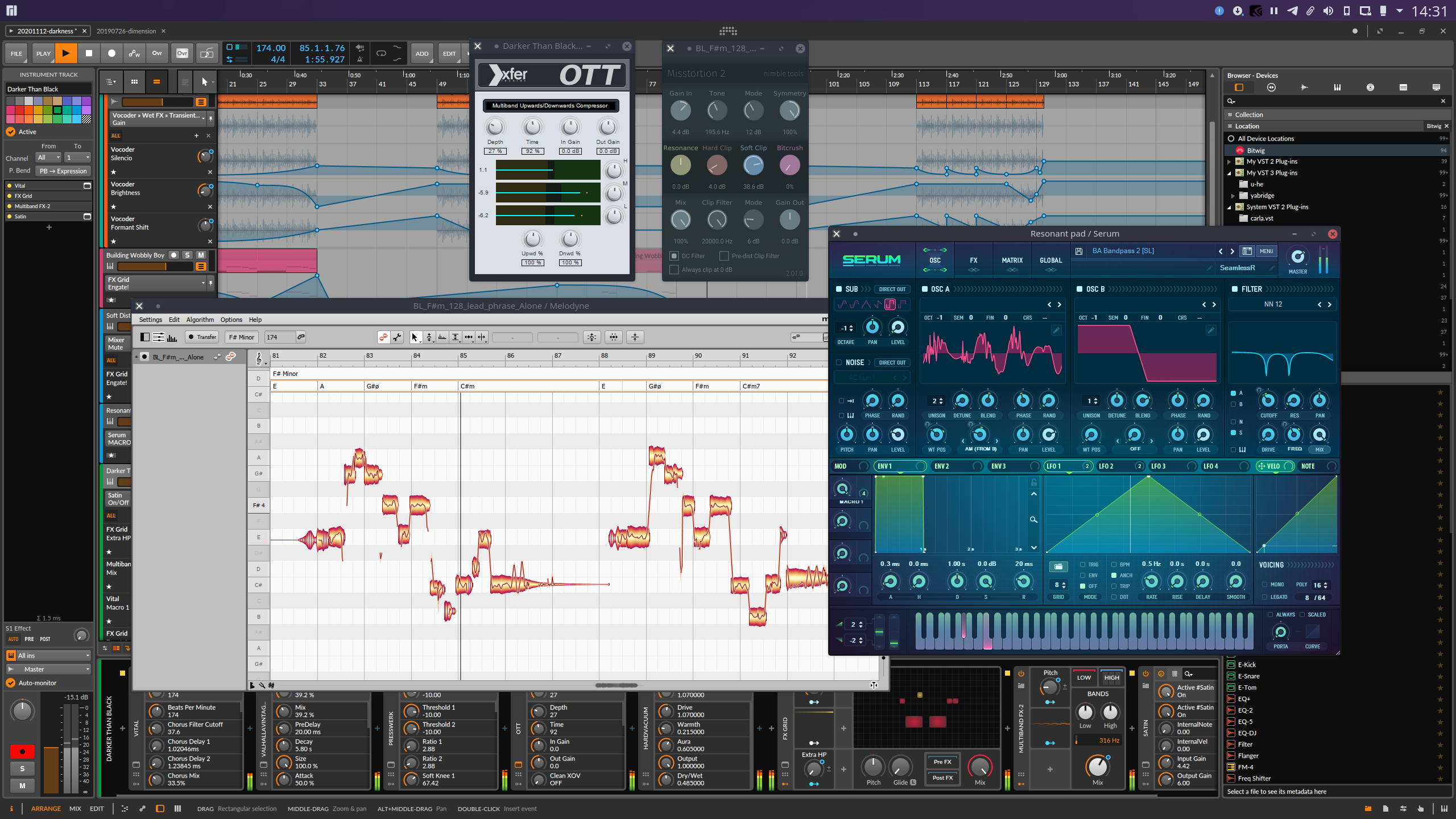
Tested with
Yabridge has been verified to work correctly in the following VST hosts using Wine Staging 5.5 and 5.6:
- Bitwig Studio 3.1 and the beta releases of 3.2
- Carla 2.1 (does not support opening multiple symlinked plugins in the same session)
- Ardour 5.12
- REAPER 6.09 (does not support symlinks)
At the moment there is a regression in Wine 5.7 that breaks application startup behavior, so you'll have to temporarily downgrade to an earlier version of Wine if you're got Wine 5.7 isntalled. Please let me know if there are any issues with other VST hosts.
Usage
You can either download a prebuilt version of yabridge through the GitHub releases section, or you can compile it from source using the instructions in the build section below.
There are two ways to use yabridge. The recommended way is to use symbolic links. The main advantage here is that you will be able to update yabridge for all of your plugins in one go, and it avoids having to install anything outside of your home directory. Sadly, not all hosts support this behavior. See the list above for hosts that don't.
If you have downloaded the prebuilt version of yabridge or if have followed the isntructions from the bitbridge section below, then yabridge is also able to load 32-bit VST plugins. The installation procedure for 32-bit plugins is exactly the same as for 64-bit plugins. Yabridge will detect whether a plugin is 32-bit or 64-bit on startup and it will handle it accordingly.
It's also possible to use yabridge with multiple Wine prefixes. Yabridge will
automatically detect and use the Wine prefix the plugin's .dll file is located
in. Alternatively you could set the WINEPREFIX environment variable to
override the Wine prefix for all instances of yabridge.
Symlinking (recommended)
This is the recommended way to use yabridge if you're using Bitwig Studio or
Ardour. You can either use the prebuilt binaries from the GitHub releases
section, or you could build yabridge directly from source. If you use the
prebuilt binaries, then you can simply extract them to ~/.local/share/yabridge
or to anywhere else in your home directory. If you choose to build from source,
then you can use the compiled binaries directly from the build/ directory. For
the section below I'm going to assume you've extracted the files to
~/.local/share/yabridge.
To set up yabridge for a VST plugin called
~/.wine/drive_c/Program Files/Steinberg/VstPlugins/plugin.dll,
simply create a symlink from ~/.local/share/yabridge/libyabridge.so to
~/.wine/drive_c/Program Files/Steinberg/VstPlugins/plugin.so like so:
ln -s ~/.local/share/yabridge/libyabridge.so "$HOME/.wine/drive_c/Program Files/Steinberg/VstPlugins/plugin.so"
As an example, if you wanted to set up yabridge for all VST plugins under
~/.wine/drive_c/Program Files/Steinberg/VstPlugins, you could run the
following script in Bash. This will skip any .dll files that are not actually
VST plugins.
yabridge_home=~/.local/share/yabridge

find "$HOME/.wine/drive_c/Program Files/Steinberg/VstPlugins" -type f -iname '*.dll' -print0 |
  xargs -0 -P$(nproc) -I{} bash -c "(winedump -j export '{}' | grep -qE 'VSTPluginMain|main|main_plugin') && printf '{}\0'" |
  sed -z 's/\.dll$/.so/' |
  xargs -0 -n1 ln -sf "$yabridge_home/libyabridge.so"
Copying
If your VST host does not have support for symlinked VST plugins, then you can
also install yabridge by creating copies of the libyabridge.so file instead of
using symlinks. For this you will have to make sure that all four of the
yabridge-host* files from the downloaded archive are somewhere in the search
path. The recommended way to do this is to download yabridge from the GitHub
releases section, extract
all the files to ~/.local/share/yabridge, and then add that directory to your
$PATH environment variable. Alternatively there's an AUR
package available if you're
running Arch or Manjaro.
The installation process for a plugin is the same as the procedure described
above, but instead of creating a symlink from libyabridge.so to plugin.so,
you'll now have to create a copy. Using the same example, if you have extracted
yabridge's files to ~/.local/share/yabridge and you want to set up yabridge
for a VST plugin called ~/.wine/drive_c/Program Files/Steinberg/VstPlugins/plugin.dll, then you should copy
~/.local/share/yabridge/libyabridge.so to ~/.wine/drive_c/Program Files/Steinberg/VstPlugins/plugin.so like so:
cp ~/.local/share/yabridge/libyabridge.so "$HOME/.wine/drive_c/Program Files/Steinberg/VstPlugins/plugin.so"
You could also use a modified version of the installation script from the previous section to install yabridge for all of you VST plugins at once:
yabridge_home=~/.local/share/yabridge

find "$HOME/.wine/drive_c/Program Files/Steinberg/VstPlugins" -type f -iname '*.dll' -print0 |
  xargs -0 -P$(nproc) -I{} bash -c "(winedump -j export '{}' | grep -qE 'VSTPluginMain|main|main_plugin') && printf '{}\0'" |
  sed -z 's/\.dll$/.so/' |
  xargs -0 -n1 cp "$yabridge_home/libyabridge.so"
Runtime dependencies and known issues
Any VST2 plugin should function out of the box, although some plugins will need some additional dependencies for their GUIs to work correctly. Notable examples include:
- Serum requires you to disable
d2d1.dllinwinecfgand to installgdiplusthroughwinetricks.
Aside from that, these are some known caveats:
- Plugins by KiloHearts have file descriptor leaks when esync is enabled,
causing Wine and yabridge to eventually stop working after the system hits the
open file limit. This sadly cannot be fixed in yabridge. Simply unset
WINEESYNCwhile using yabridge if this is an issue. - Most recent iZotope plugins don't have a functional GUI in a typical out of the box Wine setup because of missing dependencies. Please let me know if you know which dependencies are needed for these plugins to render correctly.
There are also some VST2.X extension features that have not been implemented yet because I haven't needed them myself. Let me know if you need any of these features for a certain plugin or VST host:
- Double precision audio (
processDoubleReplacing). - Vendor specific extension (for instance, for REAPER, though most of these extension functions will work out of the box without any modifications).
Building
To compile yabridge, you'll need Meson and the following dependencies:
- gcc (tested using GCC 9.2)
- A Wine installation with
wiengccand the development headers. - Boost
- xcb
The following dependencies are included in the repository as a Meson wrap:
- bitsery
The project can then be compiled as follows:
meson setup --buildtype=release --cross-file cross-wine.conf build
ninja -C build
32-bit bitbridge
It is also possible to compile a host application for yabridge that's compatible with 32-bit plugins such as old SynthEdit plugins. This will allow yabridge to act as a bitbirdge, allowing you to run old 32-bit only Windows VST2 plugins in a modern 64-bit Linux VST host. For this you'll need to have installed the 32 bit versions of the Boost and XCB libraries. This can then be set up as follows:
# Enable the bitbridge on an existing build
meson configure build -Duse-bitbridge=true
# Or configure a new build from scratch
meson setup --buildtype=release --cross-file cross-wine.conf -Duse-bitbridge=true build

ninja -C build
This will produce two files called yabridge-host-32.exe and
yabridge-host-32.exe.so. Yabridge will detect whether the plugin you're trying
to load is 32-bit or 64-bit, and will run either yabridge-host.exe or
yabridge-host-32.exe accordingly.
Debugging
Wine's error messages and warning are usually very helpful whenever a plugin doesn't work right away. Sadly this information is not always available. Bitwig, for instance, hides a plugin's STDOUT and STDERR streams from you. To make it easier to debug malfunctioning plugins, yabridge offers these two environment variables:
-
YABRIDGE_DEBUG_FILE=<path>allows you to write the Wine VST host's STDOUT and STDERR messages to a file. For instance, you could launch your DAW withenv YABRIDGE_DEBUG_FILE=/tmp/yabridge.log <daw>, and then usetail -F /tmp/yabridge.logto keep track of that file. If this option is not present then yabridge will write all of its debug messages to STDERR instead. -
YABRIDGE_DEBUG_LEVEL={0,1,2}allows you to set the verbosity of the debug information. Each level increases the amount of debug information printed:- A value of
0(the default) means that yabridge will only write messages from the Wine process and some basic information such about the plugin being loaded and the Wine prefix being used. - A value of
1will log information about most events and function calls sent between the VST host and the plugin. This filters out some noisy events such aseffEditIdle()andaudioMasterGetTime()since those are sent tens of times per second by for every plugin. - A value of
2will cause all of the events to be logged, including the events mentioned above. This is very verbose but it can be crucial for debugging plugin-specific problems.
More detailed information about these debug levels can be found in
src/common/logging.h. - A value of
Wine's own logging facilities can also
be very helpful when diagnosing problems. In particular the +message and
+relay channels are very useful to trace the execution path within loaded VST
plugin itself.
Attaching a debugger
When needed, I found the easiest way to debug the plugin to be to load it in an instance of Carla with gdb attached:
env YABRIDGE_DEBUG_FILE=/tmp/yabridge.log YABRIDGE_DEBUG_LEVEL=2 carla --gdb
Doing the same thing for the Wine VST host can be a bit tricky. You'll need to
launch winedbg in a seperate detached terminal emulator so it doesn't terminate
together with the plugin, and winedbg can be a bit picky about the arguments it
accepts. I've already set this up behind a feature flag for use in KDE Plasma.
Other desktop environments and window managers will require some slight
modifications in src/plugin/host-bridge.cpp. To enable this, simply run:
meson configure build --buildtype=debug -Duse-winedbg=true
Architecture
The project consists of two components: a Linux native VST plugin
(libyabridge.so) and a VST host that runs under Wine
(yabridge-host.exe/yabridge-host.exe.so, and
yabridge-host-32.exe/yabridge-host-32.exe.so if the bitbirdge is enabled).
I'll refer to the copy of or lthe symlink to libyabridge.so as the plugin,
the native Linux VST host that's hosting the plugin as the native VST host,
the Wine VST host application that's hosting a Windows .dll file as the Wine
VST host, and the Windows VST plugin that's being loaded in the Wine VST host
as the Windows VST plugin. The whole process works as follows:
-
Some copy of or a symlink to
libyabridge.sogets loaded as a VST plugin in a Linux VST host. This file should have been renamed to match a Windows VST plugin.dllfile in the same directory. For instance, if there's aSerum_x64.dllfile you'd like to bridge, then there should be a symlink tolibyabridge.sonamedSerum_x64.so. -
The plugin first attempts to locate and determine:
-
The Windows VST plugin
.dllfile that should be loaded. -
The architecture of that VST plugin file. This is done by inspecting the headers if the
.dllfile. -
The location of the Wine VST host. This will depend on the architecture detected for the plugin. If the plugin was copmiled for the
x86_64architecture or the 'Any CPU' target, then we will look foryabridge-host.exe. If the plugin was copmiled for thex86architecture, when we'll search foryabridge-host-32.exe.We will first search for this file alongside the actual location of
libyabridge.so. This is useful for development, as it allows you to use a symlink tolibyabridge.sodirectly from the build directory causing yabridge to automatically pick up the right version of the Wine VST host. If this file cannot be found, then it will fall back to searching through the search path. -
The Wine prefix the plugin is located in. If the
WINEPREFIXenvironment variable is specified, then that will be used instead.
-
-
The plugin then sets up a Unix domain socket endpoint to communicate with the Wine VST host somewhere in a temporary directory and starts listening on it. I chose to communicate over Unix domain sockets rather than using shared memory directly because this way you get low latency communication with without any busy waits or manual synchronisation for free. The added benefit is that it also makes it possible to send arbitrarily large chunks of data without having to split it up first. This is useful for transmitting audio and preset data which may have any arbitrary size.
-
The plugin launches the Wine VST host in the detected wine prefix, passing the name of the
.dllfile it should be loading and the path to the Unix domain socket that was just created as its arguments. -
Communication gets set up using multiple sockets over the end point created previously. This allows us to easily handle multiple data streams from different threads using blocking read operations for synchronization. Doing this greatly simplifies the way communication works without compromising on latency. The following types of events each get their own socket:
-
Calls from the native VST host to the plugin's
dispatcher()function. These get forwarded to the Windows VST plugin through the Wine VST host. -
Calls from the native VST host to the plugin's
dispatcher()function with theeffProcessEventsopcode. These also get forwarded to the Windows VST plugin through the Wine VST host. This has to be handled separately from all other events because of limitations of the Win32 API. Without doing this the plugin would not be able to receive any MIDI events while the GUI is being resized or a dropdown menu or message box is shown. -
Host callback calls from the Windows VST plugin through the
audioMasterCallbackfunction. These get forwarded to the native VST host through the plugin.Both the
dispatcher()andaudioMasterCallback()functions are handled in the same way, with some minor variations on how payload data gets serialized depending on the opcode of the event being sent. See the section below this for more details on this procedure. -
Calls from the native VST host to the plugin's
getParameter()andsetParameter()functions. Both functions get forwarded to the Windows VST plugin through the Wine VST host using a single socket because they're very similar and don't need any complicated behaviour. -
Calls from the native VST host to the plugin's
processReplacing()function. This function gets forwarded to the Windows VST plugin through the Wine VST. In the rare event that the plugin does not supportprocessReplacing()and only supports The deprecated commutativeprocess()function, then the Wine VST host will emulate the behavior ofprocessReplacing()instead. -
The Windows VST plugin's
AEffectobject. A copy of this is sent over a socket from the Wine VST hsot to the plugin after the Windows VST plugin has finished initializing. Whenever this struct gets updated by the Windows VST plugin, the Windows VST plugin will call theaudioMasterIOChanged()host callback and we'll repeat the process.
The operations described above involving the host -> plugin
dispatcher()and plugin -> hostaudioMaster()functions are all handled by first serializing the function parameters and any payload data into a binary format so they can be sent over a socket. The objects used for encoding both the requests and the responses for theses events can be found insrc/common/serialization.h, and the functions that actually read and write these objects over the sockets are located insrc/common/communication.h. The actual binary serialization is handled using bitsery.Actually sending and receiving the events happens in the
send_event()andreceive_event()functions. When calling eitherdispatch()oraudioMaster(), the caller will oftentimes either pass along some kind of data structure through the void pointer function argument, or they expect the function's return value to be a pointer to some kind of struct provided by the plugin or host. The behaviour for reading from and writing into these void pointers and returning pointers to objects when needed is encapsulated in theDispatchDataConverterandHostCallbackDataCovnerterclasses for thedispatcher()andaudioMaster()functions respectively. For operations involving the plugin editor there is also some extra glue inPluginBridge::dispatch_wrapper. On the receiving end of the function calls, thepassthrough_event()function calls the callback functions and handles the marshalling between our data types created by the*DataConverterclasses and the VST API's different pointer types. This behaviour is separated fromreceive_event()so we can handle MIDI events separately. This is needed because a select few plugins only store pointers to the received events rather than copies of the objects. Because of this, the received event data must live at least until the next audio buffer gets processed so it needs to be stored temporarily. -
-
The Wine VST host loads the Windows VST plugin and starts forwarding messages over the sockets described above.
-
After the Windows VST plugin has started loading we will forward all values from the plugin's
AEffectstruct to the Linux native VST plugin using the socket described above. After this point the plugin will stop blocking and has finished loading.